Skip to content

Client risk assessment is one of the most important—and most misunderstood—parts of human and social services case management.
Done well, it helps you answer three questions quickly and consistently:
- Is anyone in immediate danger right now?
- What level of support does this client need, and how urgently?
- What services, referrals, and follow-ups will reduce risk over time?
Done poorly, it can become a burdensome intake checklist, a source of bias, or (worst of all) a process that collects sensitive information without a clear plan for using it.
This resource is designed as a guide you can hand to program leaders, frontline staff, and quality/compliance teams, including essential resources:
- a practical client risk assessment model
- client risk assessment tools
- a downloadable client risk assessment template
What “client risk assessment” means in human and social services
In nonprofit case management, client risk assessment is a structured way to identify and respond to factors that could harm:
- the client (health, safety, housing stability, exploitation, relapse, self-harm),
- other household members (children, elders, partners),
- staff/volunteers (workplace safety, violence risk),
- and the organization (duty of care, documentation, privacy, mandated reporting).
A useful definition is: a repeatable process that turns client information into an action plan—triage, safety planning, service intensity, and follow-up.
That last part—action plan—is the difference between assessment and paperwork.
If you’re ready to operationalize it, a nonprofit-focused case management platform like Sumac can help you turn your assessment into a living workflow—intake, scoring, tasks, reassessments, and outcomes—rather than another document that sits in a folder.

A practical model: the Risk → Response loop
Think of your client risk assessment as a loop, not a one-time event:
- Identify risks and protective factors
- Assign a risk level (with definitions)
- Trigger actions (what happens next)
- Follow up and reassess (risk changes)
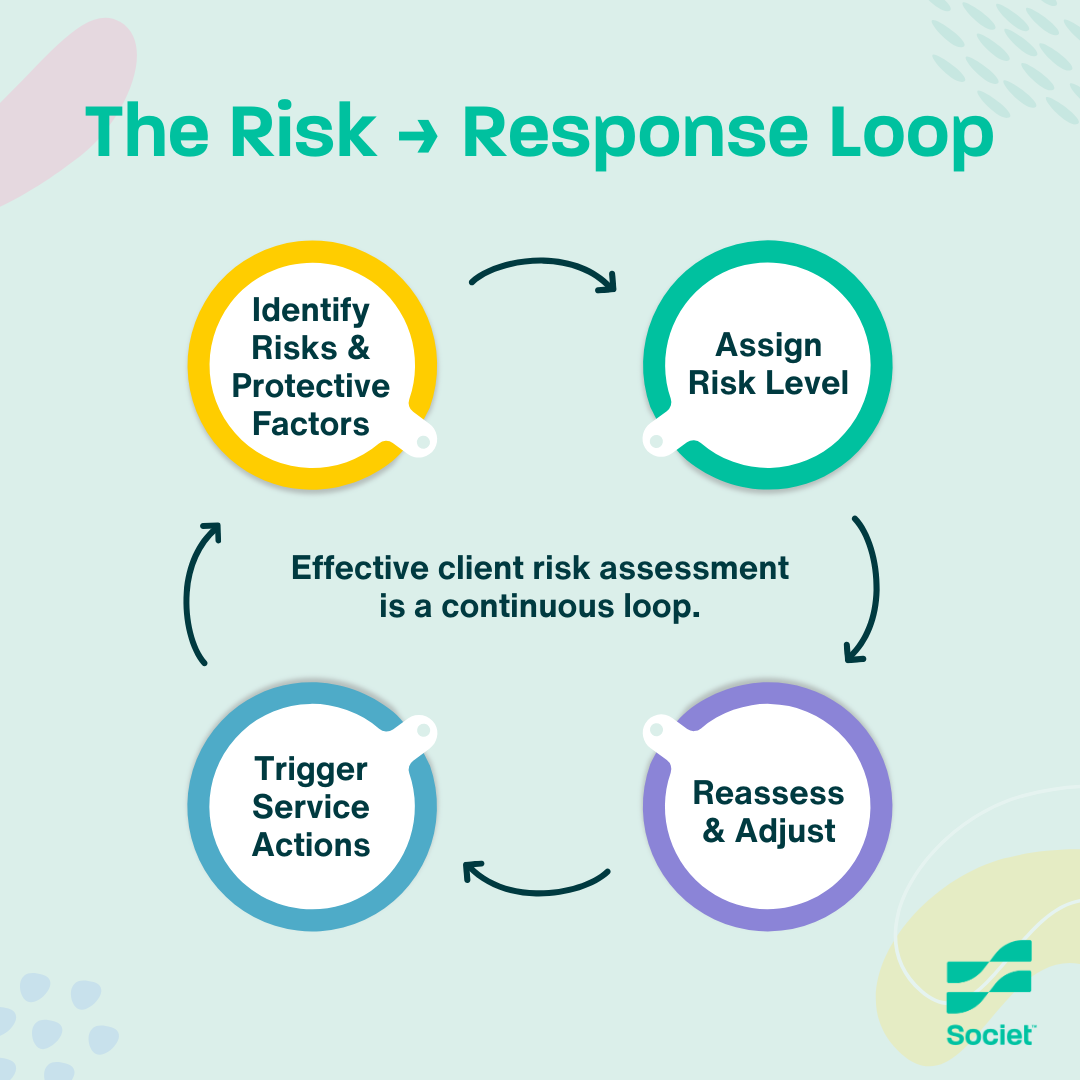
If any step is missing, the system fails:
- No risk level? You can’t triage.
- No triggers? You’re collecting data without impact.
- No reassessment? You’re freezing clients in time.
Tip: Start trauma-informed, not form-informed
Trauma-informed work prioritizes safety, trust, choice, collaboration, empowerment, and attention to cultural/historical context. SAMHSA’s trauma-informed principles are widely cited and practical for building intake and assessment experiences that don’t retraumatize clients.
Practice tip: If you can’t explain why you’re asking a question and what you will do with the answer, consider removing it—or moving it to a later stage after stabilization.
Client risk assessment template + scoring example
Below is a free downloadable client risk assessment template you can start using today.
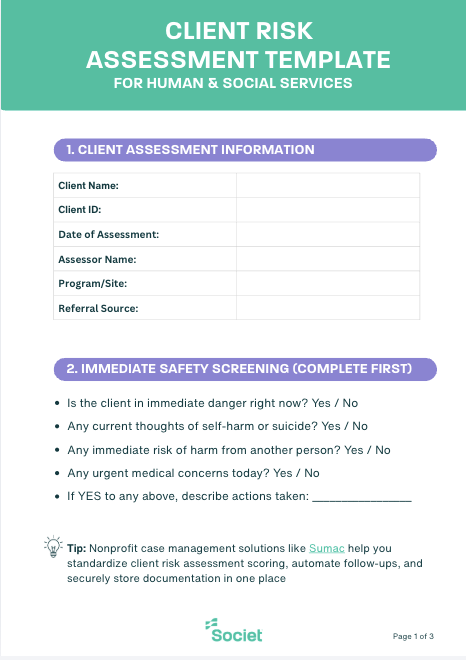
Download Client Risk Assessment Template HERE.
Want to build your own client risk assessment, instead? Here is a structure you can copy into a doc, form builder, or system configuration. Remember to keep the language plain and operational.
1) Identifiers and context
- Client name / ID
- Date/time, assessor, program/site
- Referral source
- Contact preferences and safe-contact notes (critical for IPV situations)
2) Immediate safety screening (Yes/No + notes)
- Is the client in immediate danger right now?
- Any current thoughts of self-harm or suicide? (If yes → follow your crisis protocol; consider structured screening tools appropriate to your setting.)
- Any immediate risk of harm from someone else?
- Any urgent medical needs today?
Automation idea: “Yes” answers trigger supervisor review + same-day follow-up tasks.
3) Risk domains (score each 0–3)
Use anchored definitions to reduce subjectivity.
Housing stability
- 0 = stably housed
- 1 = at risk (arrears, doubling up)
- 2 = temporary/unstable (shelter/couch surfing)
- 3 = unsheltered or imminent loss within days
Health/behavioral health
- 0 = stable
- 1 = manageable with supports
- 2 = frequent disruption (missed meds/appointments)
- 3 = acute instability/hospitalization risk
Safety/exploitation
- 0 = no current indicators
- 1 = past history, no current threat
- 2 = current concern, safety planning needed
- 3 = immediate threat, active exploitation, crisis response needed
Legal/financial instability
- 0 = stable
- 1 = mild barriers
- 2 = significant barriers (loss of income, active case)
- 3 = immediate impact on safety/housing
Engagement/access barriers
- 0 = fully accessible
- 1 = occasional barriers
- 2 = frequent barriers
- 3 = major barriers requiring intensive outreach/supports
4) Protective factors (checklist + notes)
- supportive relationships
- stable income/benefits
- safe location(s)
- coping strategies
- connection to care
- client-stated strengths
5) Overall risk level (calculated + clinical judgment)
Example:
- Low (0–4): routine case management
- Moderate (5–8): increased touchpoints + targeted referrals
- High (9–12): intensive case management + supervisor review
- Critical: any immediate safety “yes” or exploitation crisis
6) Triggered response plan (required fields)
- What happens next (today/this week/this month)?
- Who owns each task?
- Safety plan completed? (Y/N)
- Referrals made (warm handoff vs. list provided)
- Follow-up dates scheduled
7) Consent, privacy, and info-sharing notes
Document:
- consent obtained (and limitations)
- client preferences
- any legal/mandated reporting actions (if applicable)
Privacy-by-design reminder: align the template with “minimum necessary” data practices.

Tip: Use validated tools when they fit—and be explicit when they don’t
Validated screening tools reduce guesswork and improve consistency. For example:
- Substance use screening and assessment tool directories are curated by SAMHSA and NIDA.
- Suicide risk screening is commonly supported by structured approaches such as the Columbia Protocol (C-SSRS).
You don’t need a validated instrument for every domain, but you do need a consistent rubric and clear decision rules.
Key risk domains nonprofits should assess
Below are common risk domains in human and social services. You should tailor them to your mission and legal obligations.
A) Immediate safety and crisis needs (first-contact priority)
This is your “can we safely continue this conversation?” domain.
Examples:
- imminent risk of self-harm or suicide (use structured screening where appropriate)
- threats of violence, severe agitation, weapons access considerations in specific settings (especially outreach, shelters, clinics)
- recent overdose, intoxication, severe withdrawal risk
- current domestic/intimate partner violence indicators (screening workflows exist and can be adapted to service settings)
Output: safety plan, emergency response, crisis referral, warm handoff, supervisor consult.
B) Housing instability and vulnerability
For homelessness services, many communities use standardized assessment approaches in coordinated entry to match clients to housing resources and prioritize limited supply.
Even if you’re not a homelessness provider, housing risk is often a leading indicator for:
- health decline,
- victimization,
- child welfare involvement,
- and program dropout.
Output: prevention supports, shelter referral, housing navigation intensity, documentation needs.
C) Health and behavioral health complexity
You may not be diagnosing, but you are coordinating care. Consider:
- functional limitations
- medication access or adherence barriers
- chronic conditions that affect daily stability
- depression/anxiety indicators (where appropriate, use validated screens and referral pathways)
Output: care coordination plan, appointment supports, benefits navigation, referral to licensed providers.
D) Exploitation and safeguarding
Nonprofits often serve people at higher risk of:
- financial exploitation,
- human trafficking,
- coercive control,
- elder abuse,
- or unsafe caregiving arrangements.
Output: safeguarding plan, legal advocacy referral, trusted contact strategy, documentation and reporting steps.
E) Child and family safety (when relevant)
Child welfare systems often distinguish between safety (imminent harm) and risk (likelihood of future harm), supported by structured approaches and decision points.
Even outside child welfare, family-serving nonprofits should be explicit about:
- mandatory reporting triggers,
- supervision requirements,
- and how you document concerns.
Output: mandatory reporting workflow (if applicable), parenting supports, safety planning, case conferencing.
F) Program fit and service barriers
This domain is not about blame—it’s about support.
- transportation barriers
- digital access
- language access
- appointment readiness
- past program exits
Output: engagement plan, accessibility accommodations, flexible scheduling, outreach cadence.
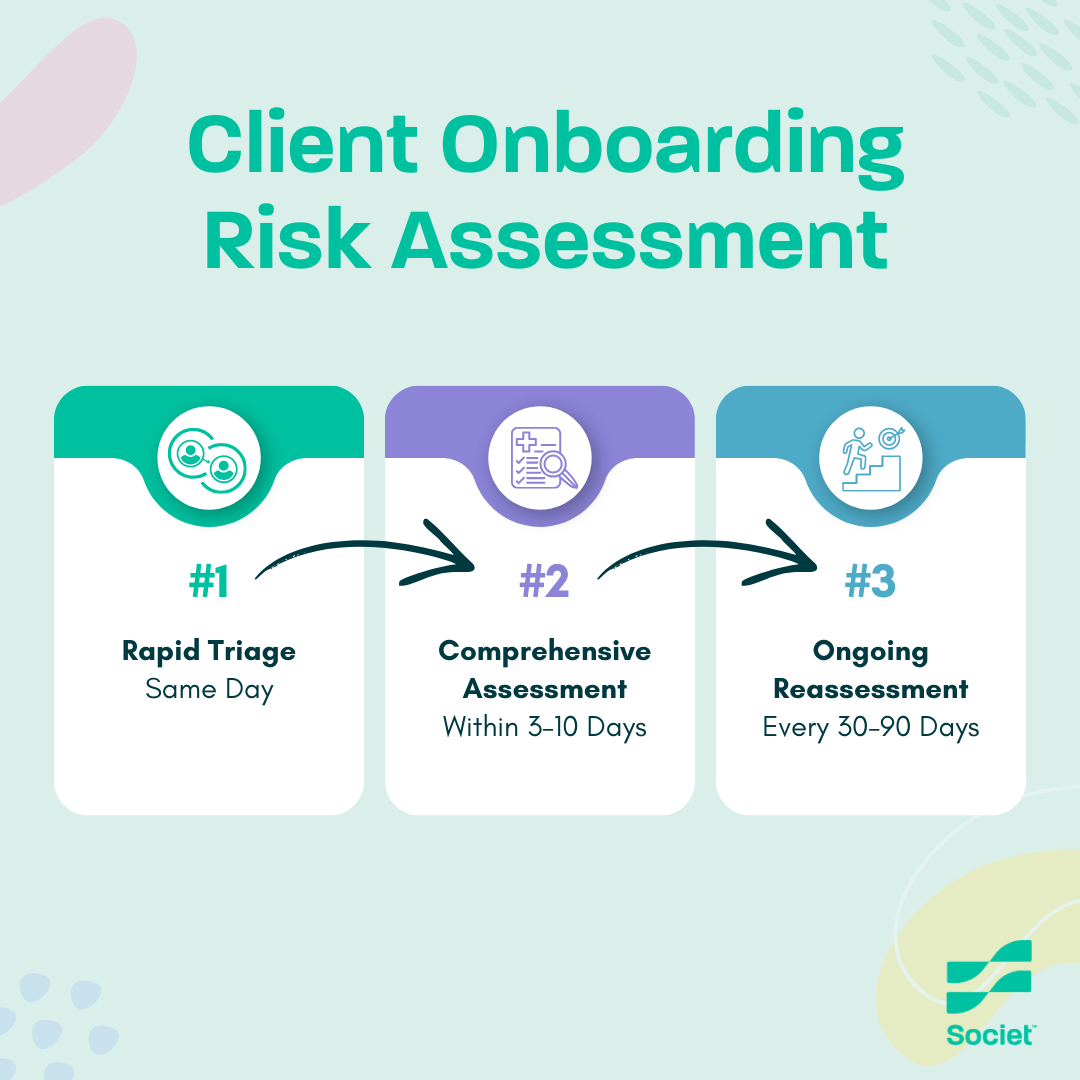
Client onboarding risk assessment: 3 stages
A strong client onboarding risk assessment is usually layered:
- Rapid screening (minutes): detect urgent safety needs and eligibility.
- Focused assessment (days): understand domains of risk and protective factors.
- Ongoing reassessment (weeks/months): update risk level as circumstances change.
This “progressive engagement” approach is common in coordinated entry and other human services workflows (multiple layers of information gathered for different purposes).
Stage 1: Rapid triage (same day)
Goal: identify crisis risk and route to the right level of help.
Include:
- immediate safety questions (brief, plain language)
- basic eligibility and contact info
- “top 1–3 needs” as stated by the client
- consent to collect/store/share info (as your context requires)
Avoid:
- deep trauma history
- long clinical inventories
- duplicative demographic questions that don’t affect service
Stage 2: Comprehensive assessment (within 3–10 days)
Goal: build a service plan with measurable next steps.
Include:
- structured risk domains (housing, health, safety, exploitation, legal, income)
- protective factors (support networks, coping skills, benefits, safe spaces)
- strengths and goals (client-defined)
- scoring rubric and supervisor review triggers
Stage 3: Ongoing reassessment (every 30–90 days, and at transitions)
Goal: detect change early and adjust service intensity.
Trigger reassessment when:
- a major life event occurs (eviction notice, hospitalization, relapse, violence)
- a client disengages unexpectedly
- a case is stepping down or closing
- services are escalating
Tip: Document “minimum necessary” data (and protect it)
Risk assessment often involves highly sensitive information. Build your workflow around the idea of collecting and sharing only what’s needed for the purpose at hand. In HIPAA-regulated contexts, HHS guidance explains the “minimum necessary” principle.
Operational implication: Your form design, staff permissions, and reporting exports should reflect this principle—not just your policy manual.
Common mistakes nonprofits make (and how to fix them)
Mistake 1: Treating the tool like a “complete history” form
Fix: Split onboarding into stages; collect only what you need today, then deepen later.
Mistake 2: Scoring without service pathways
Fix: For each risk level, define: contact frequency, required referrals, supervisor involvement, and documentation expectations.
Mistake 3: Free-text risk notes that can’t be reported on
Fix: Use structured fields for domains and triggers; keep narrative notes for context. (This is also where configurable systems like Sumac can reduce “documentation chaos” by standardizing fields and workflows.)
Mistake 4: No reassessment cadence
Fix: Set reassessment rules (time-based + event-based) and automate reminders/tasks.
Mistake 5: Over-collecting sensitive data
Fix: Apply “minimum necessary,” role-based access, and clear retention rules.
What a “good” client risk assessment tool looks like
A strong client risk assessment tool is:
- Short enough to finish (especially in crisis)
- Specific enough to score consistently
- Actionable (every level maps to a response)
- Auditable (you can review decisions later)
- Configurable by program (housing vs. youth vs. family violence)
- Safe (privacy-by-design, least-privilege access, secure notes): Think HIPAA- compliant case management software.
This is where purpose-built case management software can help. For example, Sumac human services software is designed for human and social service nonprofits and emphasizes configurable intake, case lifecycle tracking, workflows/reminders, and outcome reporting—features that map directly to the “Risk → Response loop” when implemented thoughtfully.
If your team is still scoring risk in spreadsheets or free-text notes, consider moving to a case management platform that can:
- Standardize assessment fields;
- Automate risk-based follow-ups; and
- Generate reporting that funders and auditors can understand—without asking staff to do double data entry.

Tip: Build for equity: standardize process, not assumptions
Two nonprofits can use the same risk assessment questions and still produce different outcomes if:
- staff interpret answers differently,
- scoring is vague,
- cultural context is ignored,
- or the “next step” depends on who’s working that day.
Trustworthy risk assessment means:
- clear scoring anchors,
- consistent service pathways,
- supervisory review for high-risk decisions,
- and routine audits for disparities.
Mini FAQ
A client risk assessment is a structured way to identify safety, stability, and vulnerability factors and translate them into a service response (triage, care plan, referrals, follow-ups).
A client risk assessment tool is the rubric, form, and scoring system you use to standardize how staff evaluate risk and determine what happens next.
Client onboarding risk assessment is the initial risk screening and assessment process during intake and early engagement—often staged (rapid triage → deeper assessment → reassessment).
Use the client risk assessment template structure above and adapt the risk domains and scoring anchors to your case management model, population, and local requirements.
Closing: risk assessment is a service, not a form
The best client risk assessment systems do something powerful: they make care more consistent than any one staff member, without becoming cold or mechanistic.
If you build your approach around trauma-informed principles, validated tools where appropriate, privacy-by-design, and clear risk-to-response pathways, your nonprofit will be able to:
- serve clients more safely,
- reduce staff burnout,
- and show funders a credible, repeatable method for prioritizing limited resources.
Remember, a nonprofit case management platform like Sumac can help you turn your assessment into a living workflow to provide safe, effective client care.