Skip to content

Nonprofits that provide case management services work on the front lines of community support—helping individuals navigate housing insecurity, healthcare access, mental health challenges, domestic violence recovery, disability services, and more.
In doing so, they handle extremely sensitive personal and health-related information every day.
This responsibility comes with risk.
Failing to comply with HIPAA regulations can result in costly fines, reputational damage, loss of funding, and erosion of client trust. Unfortunately, many nonprofits mistakenly believe HIPAA only applies to hospitals or large healthcare systems.
In reality, any nonprofit that stores, accesses, or transmits protected health information (PHI) during case management may be subject to HIPAA requirements.
That’s why having a clear, practical HIPAA compliance checklist is essential—especially for resource-constrained nonprofit organizations.
In this guide, we’ll walk through:
- What HIPAA compliance means for nonprofits
- Core HIPAA compliance requirements
- HIPAA compliance checklist for nonprofits
- HIPAA software compliance checklist for nonprofits
- What to include in a HIPAA compliance audit checklist
- Why a HIPAA software compliance checklist matters
- How the right case management software can help nonprofits avoid costly compliance mistakes
What Is HIPAA Compliance (and Why Nonprofits Should Care)?
The Health Insurance Portability and Accountability Act (HIPAA) establishes national standards to protect sensitive patient health information from being disclosed without consent or knowledge.
While nonprofits may not identify as “healthcare organizations,” many still qualify as covered entities or business associates if they:
- Provide health or mental health services
- Coordinate care for clients
- Maintain health-related case files
- Share data with healthcare providers
- Receive funding that requires HIPAA compliance
Even nonprofits offering social services—such as housing, addiction recovery, or crisis intervention—often collect Protected Health Information (PHI) as part of holistic case management.
How to Know If Your Nonprofit Handles ePHI
Your nonprofit likely needs to follow HIPAA requirements if you store or manage electronic Protected Health Information (ePHI).
ePHI includes health-related information that:
- Relates to a person’s physical or mental health, healthcare services, or payment for care
- Can be linked to an identifiable individual
- Is stored or transmitted electronically
This includes things like health conditions, treatment notes, or medical referrals when they are connected to identifiers such as a name, email address, phone number, date of birth, or other information that could reasonably identify a client.
If your nonprofit answers yes to all three of these questions:
- Does the data relate to health, treatment, or healthcare payment?
- Can it identify a specific individual?
- Is it stored or shared electronically?
Then the data is likely ePHI, and HIPAA compliance applies.
Why This Matters
HIPAA compliance is not optional. Violations can lead to:
- Fines ranging from $100 to $50,000 per violation
- Mandatory corrective action plans
- Audits by the Office for Civil Rights (OCR)
- Loss of donor and community trust
This makes a well-structured HIPAA compliance checklist a critical safeguard for nonprofit leaders.
Core HIPAA Compliance Requirements
Before diving into tactical steps, it’s important to understand the foundational pillars of HIPAA. Any HIPAA compliance requirements checklist should address three main rule categories:
1. The HIPAA Privacy Rule
This governs who can access PHI and how it can be shared. Nonprofits must:
- Limit access to PHI on a need-to-know basis
- Obtain proper authorization before disclosure
- Provide clients with rights to access their data
2. The HIPAA Security Rule
This focuses on how electronic PHI (ePHI) is protected through:
- Administrative safeguards
- Physical safeguards
- Technical safeguards
Having a HIPAA-compliant case management solution, like Sumac, makes complying with #1 & #2 easy.
3. The HIPAA Breach Notification Rule
With these pillars in mind, let’s move into a nonprofit-focused HIPAA compliance checklist.
The Complete HIPAA Compliance Checklist for Nonprofits
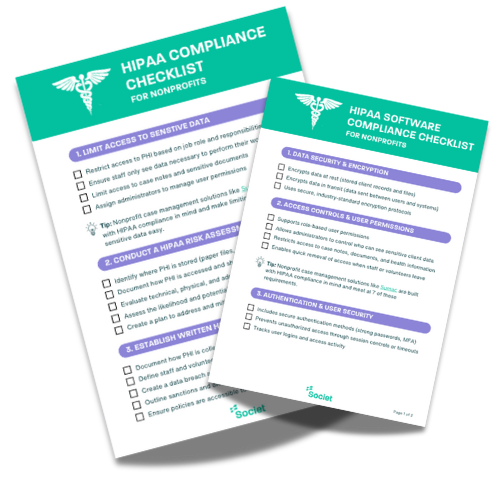
This free downloadable HIPAA compliance checklist is designed specifically for nonprofits doing case management and handling sensitive client data.
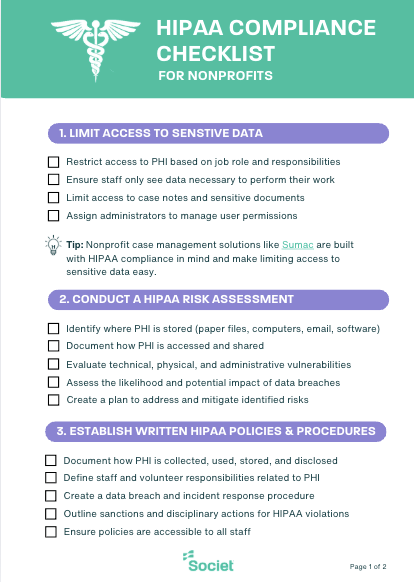
Download Nonprofit HIPAA Compliance Checklist HERE.
The 5 Parts to HIPAA Compliance:
1. Limit Access Using Role-Based Permissions
Nonprofits must ensure:
- Staff only see data relevant to their role
- Case notes are restricted appropriately
- Administrators control permission levels
This is where technology becomes essential. Human services software like Sumac are built with HIPAA compliance in mind and make limiting access to sensitive data easy.
2. Conduct a HIPAA Risk Assessment
- Identifies where PHI is stored (digital, paper, cloud)
- Evaluates potential vulnerabilities
- Assesses likelihood and impact of data breaches
Risk assessments should be reviewed annually and whenever systems or processes change.
3. Establish Written HIPAA Policies and Procedures
- How PHI is collected, stored, and shared
- Staff responsibilities
- Incident response procedures
- Sanctions for non-compliance
Policies must be documented, accessible, and regularly updated.
4. Assign a HIPAA Compliance Officer
- Overseeing compliance efforts
- Monitoring policy enforcement
- Coordinating audits and training
Even small nonprofits need clear accountability.
5. Train Staff and Volunteers Regularly
- What PHI is
- How to handle sensitive client data
- How to identify phishing or security threats
- What to do if a breach occurs
Training should be mandatory for all employees and volunteers, not just case managers.
HIPAA Software Compliance Checklist: Why Your Tools Matter
A major part of modern HIPAA compliance depends on the software your nonprofit uses. Nonprofits often underestimate how much sensitive data flows through their systems:
- Client health histories
- Intake assessments
- Case notes
- Referrals and reports
- Communication logs
If this data is stored in tools that weren’t designed for HIPAA, your organization is exposed—regardless of good intentions.
This free downloadable HIPAA software compliance checklist is designed to help nonprofits verify that their case management software meets the HIPAA requirements.
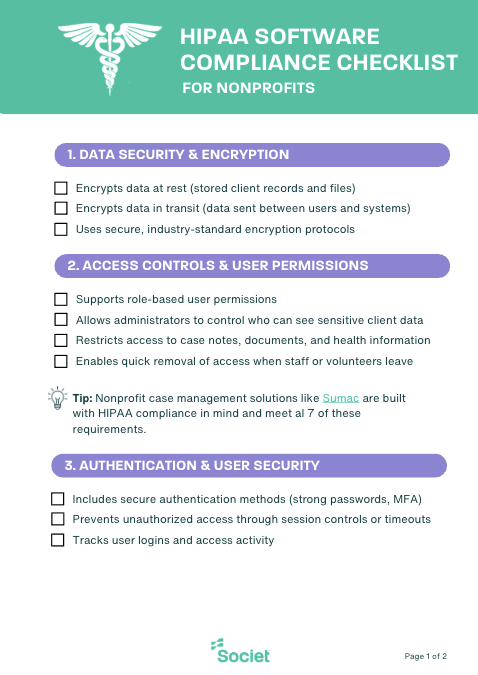
Download HIPAA Software Compliance Checklist HERE.
The 6 Parts to HIPAA Software Compliance
HIPAA compliance is not just about policies—it depends heavily on the technology you use every day. Case management software built for nonprofits, like Sumac, helps organizations meet HIPAA and PIPEDA requirements by offering role-based permissions, secure data storage, audit logging, and compliance-ready infrastructure.
1. Data Security & Encryption
- Encrypts data at rest (stored client records and files)
- Encrypts data in transit (data sent between users and systems)
- Uses secure, industry-standard encryption protocols
2. Access Controls & User Permissions
- Supports role-based user permissions
- Allows administrators to control who can see sensitive client data
- Restricts access to case notes, documents, and health information
- Enables quick removal of access when staff or volunteers leave
3. Authentication & User Security
- Includes secure authentication methods (strong passwords, MFA where available)
- Prevents unauthorized access through session controls or timeouts
- Tracks user logins and access activity
4. Audit Logs & Monitoring
- Maintains detailed audit logs
- Records who accessed PHI, when, and what actions were taken
- Supports audit reviews for HIPAA compliance audits
5. Data Backup & Reliability
- Provides automatic, reliable data backups
- Ensures data recovery in the event of system failure or breach
- Protects against accidental data loss or corruption
6. Vendor Compliance & Legal Safeguards
- Vendor signs a Business Associate Agreement (BAA)
- Software is designed to support HIPAA compliance requirements
- Vendor demonstrates ongoing security and compliance practices
Generic spreadsheets, unsecured CRMs, or free tools are not sufficient for HIPAA compliance.
HIPAA Compliance Audit Checklist for Nonprofits
HIPAA audits don’t just happen to large healthcare providers. Nonprofits are increasingly subject to audits—especially if they receive public funding or experience a breach.
A strong HIPAA compliance audit checklist should include:
Administrative Safeguards
- Documented risk assessments
- Written HIPAA policies
- Proof of staff training
- Incident response plans
- Vendor management processes
Technical Safeguards
- Access controls and user permissions
- Encryption standards
- System activity monitoring
- Secure login protocols
Physical Safeguards
- Secure workstations
- Controlled access to offices
- Policies for remote work and device use
Audits are much less stressful when compliance is built into daily operations—not retrofitted after a problem arises.
Common HIPAA Compliance Mistakes Nonprofits Make
Even well-intentioned nonprofits fall into common traps, including:
- Sharing login credentials
- Using non-secure email for client communication
- Storing PHI in spreadsheets or personal drives
- Failing to revoke access when staff leave
- Not auditing user activity
These mistakes are often the result of using systems not designed for nonprofit case management.
How Sumac Helps Nonprofits Meet HIPAA Compliance Requirements
This is where Sumac stands out.
Sumac is a nonprofit case management solution designed with compliance in mind, helping organizations meet HIPAA and PIPEDA requirements without needing enterprise-level IT resources.
HIPAA-Ready by Design
Sumac was built specifically to support nonprofits that manage sensitive client data. Instead of forcing organizations to patch together compliance, Sumac integrates HIPAA-aligned practices directly into its platform.
Role-Based User Permissions
With Sumac, nonprofits can:
- Control exactly who can see sensitive client information
- Restrict access to case notes, documents, and records
- Ensure staff only access what they need for their role
This significantly reduces the risk of internal data exposure.
World-Class Data Security
Sumac provides:
- Secure cloud-based data storage
- Strong encryption protocols
- Regular security updates
- Robust access logging for audits
These technical safeguards help nonprofits meet key requirements on any HIPAA software compliance checklist.
Designed to Help Avoid Costly Fines
HIPAA violations are expensive—and devastating for nonprofits operating on tight budgets. Sumac was intentionally designed to help organizations:
- Reduce compliance risk
- Standardize data handling
- Prepare for audits
- Demonstrate due diligence
Rather than reacting to compliance issues after they occur, Sumac enables proactive protection.
HIPAA and PIPEDA Compliance for Canadian and Cross-Border Nonprofits
Many nonprofits operate across borders or serve clients in multiple jurisdictions. Sumac supports both HIPAA and PIPEDA compliance, making it an excellent choice for organizations that must navigate overlapping regulatory environments.
This dual compliance ensures:
- Strong privacy protections for all clients
- Confidence when working with healthcare partners
- Alignment with funder and government expectations
A Note for Ontario Nonprofits: What Is PHIPA?
For nonprofits operating in Ontario, PHIPA (the Personal Health Information Protection Act) is the provincial law that governs how personal health information is collected, used, and disclosed.
PHIPA applies to organizations that handle personal health information (PHI) in Ontario, including many nonprofits that provide or coordinate health and social services.
- Limit access to personal health information
- Protect data using appropriate security safeguards
- Ensure information is only used for authorized purposes
- Be accountable for how client data is managed and shared
If your nonprofit collects health-related information as part of case management—such as assessments, treatment notes, or referrals—you may be required to comply with PHIPA, even if healthcare is not your primary focus.
HIPAA and PHIPA: Different Laws, Similar Responsibilities
While HIPAA applies in the United States and PHIPA applies in Ontario, both laws share the same core goal: protecting sensitive client health information.
That’s why nonprofits operating in Canada, the U.S., or across borders benefit from using case management software—like Sumac—that is designed to support both HIPAA and PHIPA (via PIPEDA-aligned practices), helping organizations meet privacy obligations while reducing compliance risk.
Bringing It All Together: Your Nonprofit HIPAA Compliance Checklist
To recap, a comprehensive HIPAA compliance checklist for nonprofits doing case management should include:
- Risk assessments
- Written policies and procedures
- Staff training
- Role-based access controls
- Secure, compliant software
- Regular audits and monitoring
Compliance isn’t just a legal requirement—it’s a commitment to protecting the dignity, privacy, and trust of the people you serve.
Final Thoughts: Compliance Doesn’t Have to Be Complicated
HIPAA compliance can feel overwhelming, especially for nonprofits with limited staff and budgets. But with the right systems in place, it becomes manageable—and even empowering.
By choosing a nonprofit-focused case management solution like Sumac, organizations can:
- Simplify compliance
- Protect sensitive client data
- Avoid costly fines
- Focus more time and energy on their mission
If your nonprofit is serious about case management, data security, and long-term sustainability, a purpose-built, HIPAA-compliant solution isn’t a luxury—it’s a necessity.